The McGraw-Hill 36-Hour Course: Online Marketing (McGraw-Hill 36-Hour Courses) by Lorrie Thomas
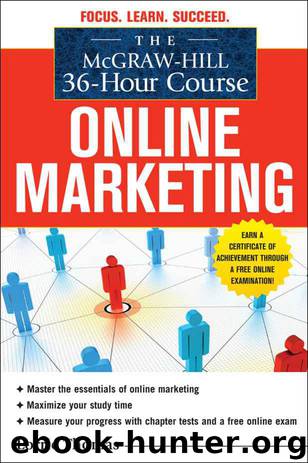
Author:Lorrie Thomas [Thomas, Lorrie]
Language: eng
Format: mobi
Publisher: McGraw-Hill
Published: 2010-12-27T14:00:00+00:00
SiteScan then reports each page in an easy-to-read file after you’ve installed the tool. This makes it easy for you to isolate the pages with tracking problems, fix them, and effectively manage your Google Analytics Tracking Code installation.
URL Builder
Google’s URL Builder allows you to measure the success of specific online marketing initiatives by tagging your online ad URLs with specific information (like campaign, medium, and source), so that Google Analytics can track your marketing campaign and show you which activities (pay-per-click ads, Twitter links, blog mentions, etc.) are paying off. If you want to track specific marketing elements (like a text link versus a button in an e-mail marketing piece), you can create a unique link for each element you want to track in your marketing e-mails, social media campaigns, and pay-per-click (PPC) ads with the URL Builder tool (http://www.google.com/support/googleanalytics/bin/answer.py?hl=en&answer=55578).
Filter Yourself
Google Analytics has a filter option that further ensures the accuracy of monthly data, allowing you to remove your web use as well as that of your organization, your colleagues, and even your webmaster. Sometimes internal organization web use can really skew data. To create filters with Google Analytics, start by visiting www.myipaddress.com to get the code for your unique IP address, then put it into the Google Analytics filter, and your Analytics report will only collect visitors’ data from people who are not filtered by the IP addresses. Filters give you a better picture of your actual monthly traffic patterns—specifically, the people you are trying to serve, support, and sell.
THE ART OF WEB ANALYTICS: AVOID ANALYSIS PARALYSIS AND FOCUS ON THE METRICS THAT MATTER
Web analytics can help you improve user experience by shedding light on how people find, use, and navigate your website, as well as segment out characteristics of your most profitable site visitors to drive more traffic and boost your sales.
When we think of web analytics, most people think of data. Lots and lots of data. So how do you avoid analysis paralysis and help ensure your analytics efforts are paying off?
While collecting data (the science) is definitely a large part of web analytics, the artful part is being able to analyze your data so that you can make optimizations and identify necessary actions.
After about a week or two (depending on the website’s traffic volume), there’s sufficient information to start gaining insights and make some decisions about how to optimize the website. Make it a daily, weekly, or monthly ritual to review data. Practice makes perfect, so the more often you drill down to see what the data holds, the more natural the art of analysis will become. The great news with analytics is that you can’t mess it up. You can click all day long and if you get lost, you can always go back to the dashboard and start over. The sooner you work web marketing measurement into the overall marketing plan, the sooner you will wonder why you didn’t start sooner!
Interpreting Web Analytics—Focus on Content
To get the best performance from your website, you need to constantly test both the medium and the message.
Download
This site does not store any files on its server. We only index and link to content provided by other sites. Please contact the content providers to delete copyright contents if any and email us, we'll remove relevant links or contents immediately.
The Brazilian Economy since the Great Financial Crisis of 20072008 by Philip Arestis Carolina Troncoso Baltar & Daniela Magalhães Prates(366339)
International Integration of the Brazilian Economy by Elias C. Grivoyannis(111613)
The Art of Coaching by Elena Aguilar(53673)
Flexible Working by Dale Gemma;(23362)
How to Stop Living Paycheck to Paycheck by Avery Breyer(19837)
Thinking, Fast and Slow by Kahneman Daniel(12538)
The Acquirer's Multiple: How the Billionaire Contrarians of Deep Value Beat the Market by Tobias Carlisle(12433)
The Radium Girls by Kate Moore(12194)
The Art of Thinking Clearly by Rolf Dobelli(10721)
Hit Refresh by Satya Nadella(9263)
The Compound Effect by Darren Hardy(9169)
Tools of Titans by Timothy Ferriss(8603)
Atomic Habits: Tiny Changes, Remarkable Results by James Clear(8526)
Turbulence by E. J. Noyes(8220)
A Court of Wings and Ruin by Sarah J. Maas(8120)
Change Your Questions, Change Your Life by Marilee Adams(7938)
Nudge - Improving Decisions about Health, Wealth, and Happiness by Thaler Sunstein(7863)
How to Be a Bawse: A Guide to Conquering Life by Lilly Singh(7618)
Win Bigly by Scott Adams(7350)
